I have found that the biggest mistake small businesses make isn’t deliberately breaking labour laws but rather on executing processes ad hoc. If these practices are not formally documented and adopted, small businesses have nothing to fall back on when they get inspected or when they are challenged. I have identified the top 5 employment compliance processes every South African small business should have to highlight the importance of labour compliance, especially for small businesses that are growing. I have been to the CCMA (Commission for Conciliation, Mediation and Arbitration) and speak from experience.
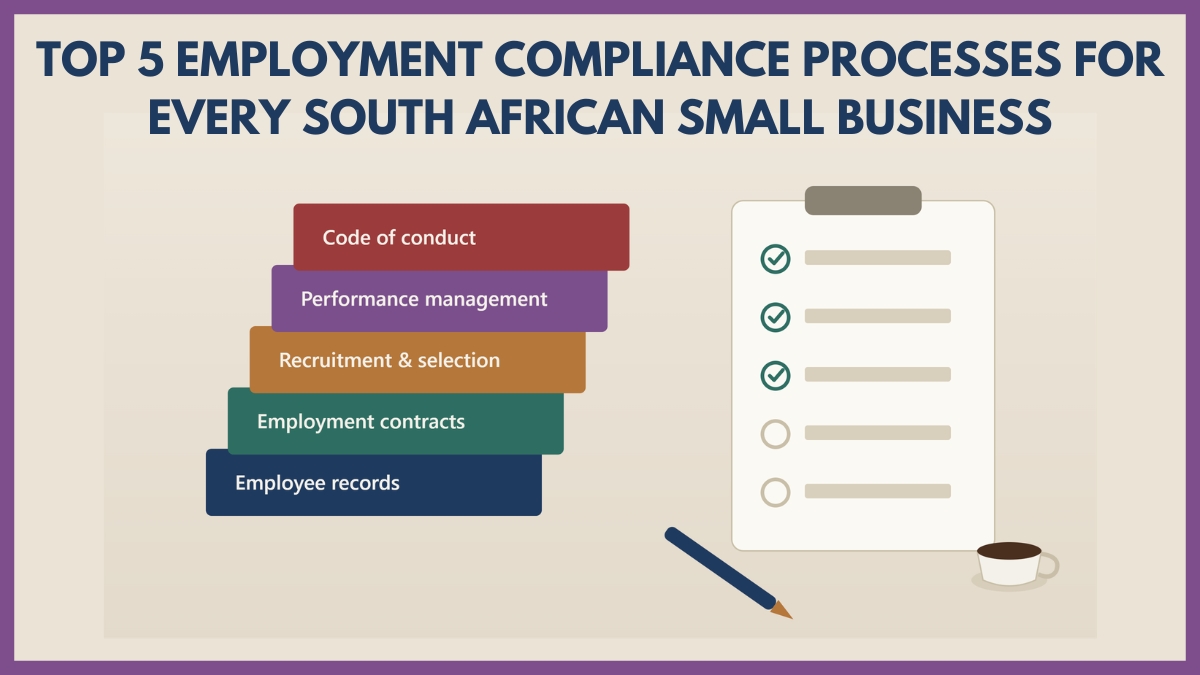
Over the last few years, I’ve had the privilege of developing, implementing and overseeing employment, governance and operational systems for small businesses I founded. While every business is unique, there are certain employment processes that literally came through for me. These are my top ten, not because legislation lists them this way, but because I’ve seen first-hand how they helped us reduce risk, manage people fairly and build more sustainable and bankable businesses.
1. Employee Records
When labour inspectors visit your business, the first thing they typically request is your employee records. They will sit down with you and ask to see the total number of employees on record, and may even walk through the premises to observe that this number matches what you have submitted. If your employee records are not up to date, and you lack a clear process for ensuring that every employee has a complete file, inspections can quickly become a painful experience.
Where possible these processes must be outsourced to the experts. These include the administration of the payroll, issuing of payslips, payment of PAYE, UIF and SDL etc. There are also monthly tax returns and bi-annual returns and when out of sync, these can cause endless issues. My advice:
- Use a system such as Sage Payroll or Zoho – even if you have a few employees, the cost per employee is low but the benefits are massive.
- Understand these processes well and even if you outsource, make sure you can ask the right questions.
- Do not miss SARS payments, especially if your payroll is larger. SARS will charge penalties. Rather negotiate to pay over a few months if cash flow is unfavourable.
- Check that your monthly submission to the Dept of Labour takes place – in many cases the systems at the Department are not accepting files and this can easily create a backlog. Terminated employees will have no access to UIF benefits if submissions are missing!
2. Recruitment and selection
The process to recruit employees into the business is one of the most significant processes that impacts whether your business is successful or not. This is because smaller businesses must balance the level of skill required by the business against affordability. In other words, smaller businesses require the level of skill they normally cannot afford. In another article, I will touch on the aspect of mechanisms that can be applied to get access to skill in a way that will not break the bank. Here are my key lessons on recruitment and selection:
- Even if you are employing 2 or 3 people, contracts must be in place
- Always have a contract signed before an employee starts. Something goes wrong in the first few days, and they may not be covered by insurance
- Use the probation period effectively and start immediately with performance management
- Ensure that the contract is POPIA compliant as you may be required from time to time to disclose employee information, for example when looking for funding
3. Employment Contracting
An employment contract forms the legal basis of the relationship between the employer and the employee and details the basis of employment. This specifies whether the employment is permanent, contract and includes details on salaries, overtime, deductions, benefits etc. and how and under what circumstances it will terminate. My key lessons:
Filing under Section 71 of the Companies Act 71 of 2008, he argued that Khutsong had fundamentally breached his fiduciary duties by prioritising personal interests over the company’s wellbeing.
4. Performance Management
Run a performance management process in line with your performance management policy as a matter of practice. But more importantly make sure that this process is clear in terms of the management of under-performance and it is in line with the prescripts of the law. Businesses, particularly small businesses cannot afford to have employees that are not pulling their weight.
There is usually limited succession and one person not doing their work in full means s devastating impact on the whole business. My advice:
- Do not dismiss any employee on the basis of under-performance unless you have gone through a formal performance improvement process that includes training, coaching, etc.
- Keep all the records of performance improvement process
5. Code of Conduct
A written Code of Conduct is one of the most important workplace documents a small business can have. It establishes the standards of behaviour expected from employees, promotes consistency in the workplace, and ensures that everyone understands what is acceptable and what is not. The Code should address issues such as attendance, punctuality, honesty, confidentiality, use of company property, workplace relationships, health and safety, harassment, and any other standards that are important to your business. Every employee should receive a copy of the Code when they join the organisation and acknowledge that they have read and understood its contents.
The real value of a Code of Conduct becomes evident when misconduct occurs. Disciplinary action should always be based on clear workplace rules that have been communicated to employees in advance. A well-drafted Code provides the foundation for fair and consistent discipline by linking different types of misconduct to appropriate sanctions, ranging from counselling and written warnings to dismissal for serious offences. Without a written Code, employers often struggle to demonstrate that employees were aware of the required standards or that disciplinary action was applied consistently.
While the law does not make a written Code of Conduct compulsory, it is one of the most effective tools for reducing disputes, supporting fair disciplinary hearings, and protecting the business if a dismissal is challenged.
Other Key Processes
In addition to the top 5, there are other process that are key to workplace harmony, including
- Employee Termination
- Grievance procedure
- Employee Health and Safety, including registration in terms of Compensation for Occupational Injuries and Diseases Act (COIDA)
Labour Compliance for Employers with 10 or less Employees
A common misconception among small business owners is that employing ten or fewer employees exempts them from the Basic Conditions of Employment Act (BCEA). While the Act does provide limited administrative concessions for very small employers, these relate mainly to simplified record-keeping and documentation requirements. They do not exempt businesses from complying with the core rights afforded to employees.
Regardless of the size of your business, you must still pay at least the National Minimum Wage, provide annual, sick and family responsibility leave where applicable, comply with working hour and overtime provisions, observe public holiday and notice period requirements, and ensure that dismissals are both procedurally and substantively fair. The concessions available to employers with ten or fewer employees simply reduce some of the administrative burden, such as maintaining simplified employment records and providing less detailed employment documentation.
In practice, every small business should have, at a minimum, written employment agreements, accurate payroll records, leave records, and workplace policies that comply with the BCEA and other applicable labour legislation. Good labour compliance not only reduces legal risk but also creates a more professional and trustworthy workplace for both employers and employees.
Conclusion
For small businesses in particular, where resources are often limited and owner-managers wear multiple hats, investing time in developing practical workplace policies can prevent costly disputes, improve employee relations, and create a more productive and professional working environment. Good policies do not just protect your business when something goes wrong, they help build a culture to make sure things go right.
Further reading
For other guides and articles on governance, please refer to that section of our site.